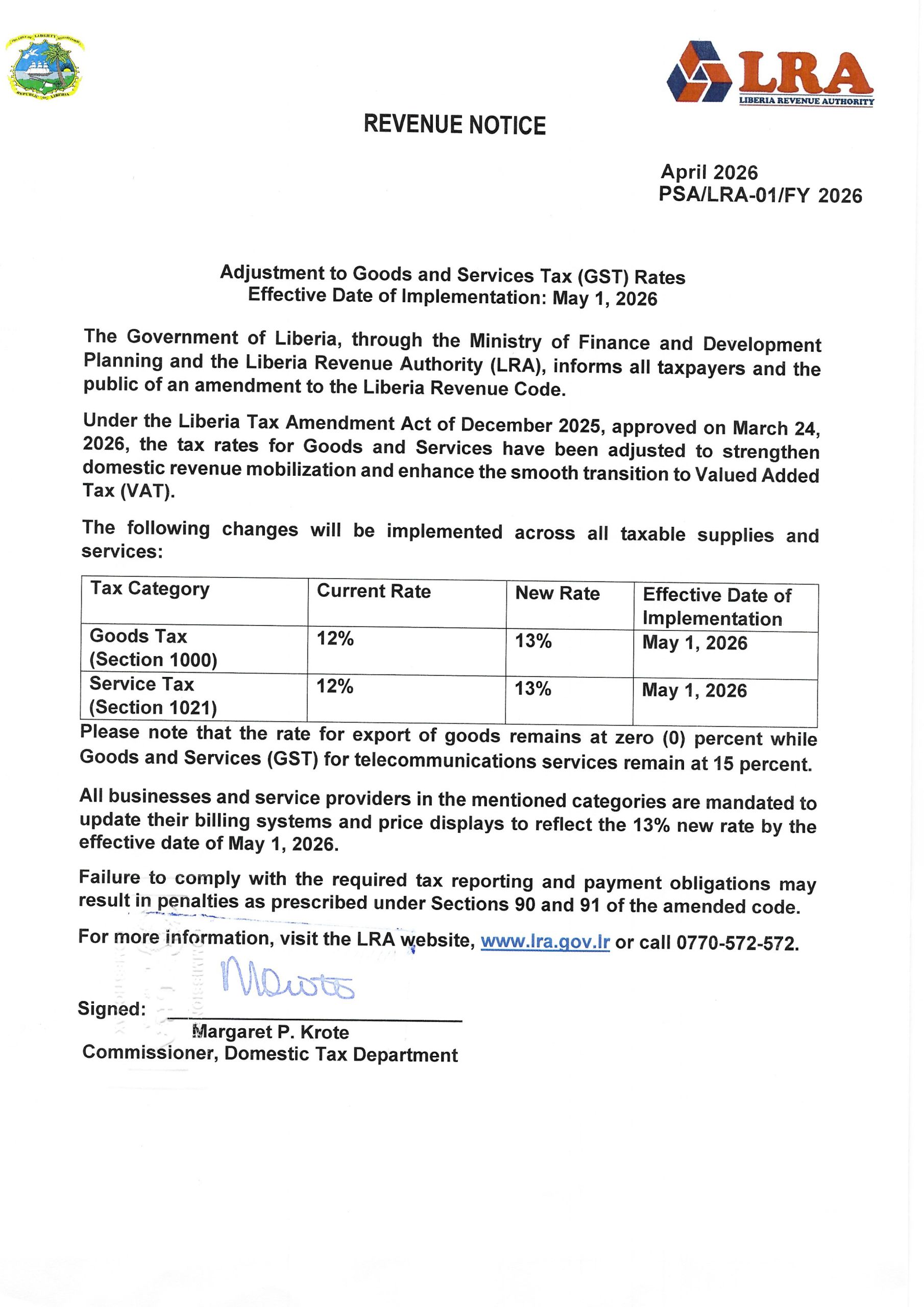
The Government of Liberia has announced a series of forward-looking enhancements to the country’s tax system following the passage of the Liberia Tax Amendment Act of December 2025, approved on March 24, 2026, and published on April 1, 2026.
These updates reflect a deliberate effort to build a stronger, more transparent, and more inclusive economy, while ensuring that the tax system keeps pace with Liberia’s evolving development needs.
At the center of the reform is a refinement of the Goods and Services Tax (GST), a consumption-based tax applied to certain services at the point they are provided. The updated framework introduces a 13 percent GST on services while maintaining the rate on telecommunications services at 15 percent.
The approach will help align taxation with expanding sectors of the economy while supporting improved public service delivery. The new GST rate represents a modest adjustment from the previous 12 percent rate, reflecting a gradual and balanced approach to strengthening domestic revenue while maintaining affordability for consumers and businesses.
Beyond GST reforms, the Act introduces a range of complementary measures aimed at strengthening tax administration, improving compliance, and aligning Liberia’s fiscal regime with international best practices. Among the key changes are enhanced provisions for tax withholding obligations, stricter penalties for tax evasion, and clearer enforcement mechanisms including departure prohibition orders for delinquent taxpayers.
The amendment also reinforces rules on Permanent Establishment, ensuring that non-resident entities operating in Liberia are appropriately taxed. This is expected to close loopholes that previously allowed revenue leakage and to promote fairness between resident and non-resident businesses.
In the area of excise taxation, the Act introduces automatic annual adjustments to excise rates on products such as tobacco, alcohol, and sugar-sweetened beverages. These adjustments will be linked to inflation and economic growth indicators, ensuring that excise taxes remain effective over time without requiring frequent legislative intervention.
Additionally, the law strengthens provisions on income sourcing, withholding taxes on payments to non-residents, and compliance requirements for licensing and registration. It also introduces clearer penalties for failure to meet tax obligations, including fines and potential imprisonment for serious offenses.
The Government notes that these reforms are designed to broaden the tax base, enhance transparency, and support sustainable domestic revenue mobilization. The measures also reflect Liberia’s commitment to international tax standards, including efforts to address base erosion and profit shifting.
The implementation of the Act by the Liberia Revenue Authority begins on May 1 this year, signaling the Government’s urgency in implementing reforms that support economic stability and national development.